Sleep Science · March 2026
How to choose a mattress quickly, easily, and correctly?
Choosing a mattress is actually much more complicated than it seems. You’re usually faced with dozens of models, different technologies, multiple layers, numbers without much context, and terms like “orthopaedic,” “anatomical,” and “ergonomic” — words we’ve all heard, but rarely understand the real difference between.
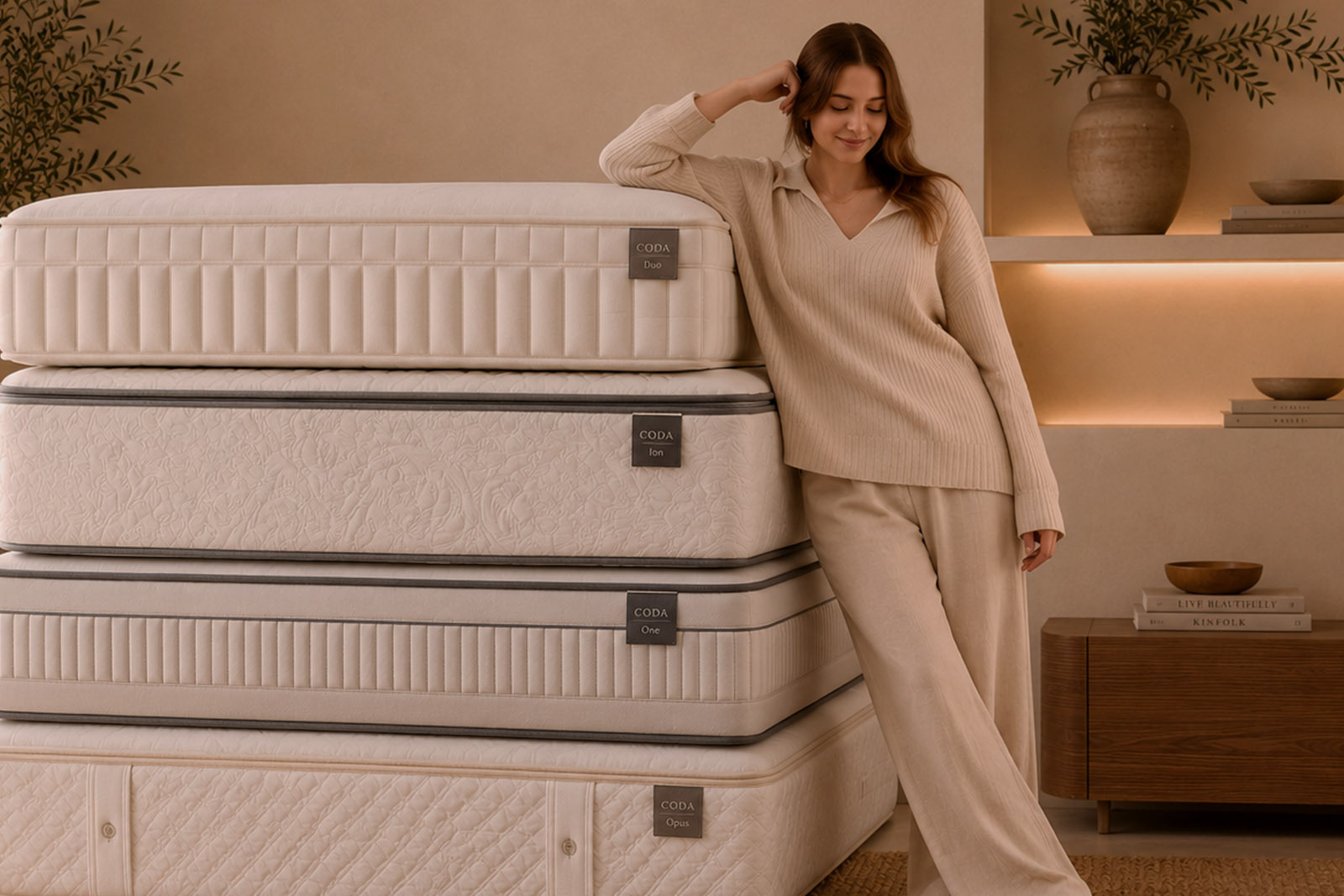
That’s why many people end up buying a mattress that just seems “good enough,” after spending 20 minutes in complete confusion in the store. The problem is that they then sleep on it for an average of 8 to 10 years.
To help you avoid choosing at random, we’ve prepared a short guide with the 5 most important questions that will help you find the right mattress for you.
1. How do you sleep?
Sleeping position
The position you sleep in is one of the most important factors when choosing a mattress.
- If you sleep on your side, the greatest pressure is placed on your shoulders and hips. A mattress that is too firm creates tension in these areas and often leads to stiffness in the morning. In this case, the surface should offer enough cushioning and adaptability (check out CODA ARC).
- If you sleep on your back, support in the lower back area is most important. The mattress should maintain the natural curve of your spine without allowing your body to sink in too deeply. Precise zoned support is also a good idea (check out CODA ION and CODA OPUS).
- If you sleep on your stomach – which is also the most demanding position for the spine – it is recommended to choose a firmer surface. This prevents the pelvis from sinking and creating additional strain in the lower back (check out CODA DUO).
Weight also matters
Weight directly affects the feeling of firmness. Heavier people sink deeper into the mattress and usually need more stable support. Otherwise, even a medium-firm mattress can start to feel too soft relatively quickly.
2. Do you sleep alone or with a partner?
When you share your bed with another person, the choice becomes even more complex. You now have to consider two different bodies, two different sleeping positions, and often two different preferences for temperature and firmness.
Here, two factors are most important:
- one person’s movement should not transfer to the other;
- the mattress should adapt to different body types at the same time.
Traditional Bonnell spring mattresses transfer movement across the entire surface. If your partner moves often during the night, there’s a high chance you’ll feel it too.
Foam mattresses handle motion isolation significantly better. They absorb movement and create a sense of calm and “hugging” comfort.
In pocket spring mattresses, each spring works independently. This means less motion transfer, better adaptation to different body areas, and improved airflow.
Hybrid mattresses combine the best of both worlds — the stable support and breathability of pocket springs with the comfort and adaptability of high-quality foams.
3. Do you feel hot at night?
Sleeping temperature has a huge impact on the quality of your rest and your mood in the morning.
If you often wake up sweaty or feel overheated during the night, the cause may not be the room itself, but the mattress.
In such cases, it is a good idea to choose a mattress with a spring core, as it allows better air circulation and natural ventilation, contributing to thermal comfort throughout the night.
4. Do you have pain — and where?
Pain in the lower back, shoulders, or neck can be related to an unsuitable mattress. But the issue is not always its firmness. More important is whether it provides proper support exactly where your body needs it.
- If you have lower back pain, both too-soft and too-firm mattresses can cause discomfort. The best solution is usually a zoned support model that supports the lumbar area without creating unnecessary tension (CODA ION and CODA OPUS).
- If the pain is in your shoulders and you sleep on your side, a firm surface is often the main cause. In this case, an additional comfort layer is not a luxury but a necessity (CODA ARC).
5. How long will you use it — and how do you test it?
We spend one-third of our lives sleeping. When you think about it that way, the investment is spread over thousands of nights and needs to be worth it so you feel good every morning and every day.
The paradox is that most people make a decision after just a few minutes of testing in a store, which is rarely enough to really understand whether a mattress is right for you.
That’s why you should test it properly, in your usual sleeping position, and for at least 15 minutes per model.
After going through the 5 questions, you rarely end up with a single clear direction. More often, you get a combination of needs — a bit more support but also comfort; a need for coolness but also stability; softness in certain areas without losing overall support.
And that’s exactly where the choice stops being “foam or springs” as separate categories. It becomes about how these features work together in the same mattress.
That’s exactly what CODA is built on: a combination of independent pocket springs and an adaptive comfort layer that works in harmony across different bodies and sleeping positions. The result is:
- Good motion isolation. Pocket springs work independently, so your partner’s movement isn’t transferred across the mattress, giving you a calm sleep and even calmer mornings.
- Good airflow. The spring construction allows natural air circulation, helping the mattress stay cooler at night and preventing moisture retention.
- Support without excessive sinking. The comfort layer softens pressure points, while the base keeps the spine stable and properly aligned throughout the night.
Before you decide
- Choose firmness based on your sleeping position. There is no “universal” firmness — only one that fits your body and sleeping style. Think about a mattress you slept well on and the feeling it gave you.
- Think in years, not days. A mattress is one of the few purchases you use every single night and that directly affects your daily life and mood. A small price difference often means a huge difference in sleep quality.