Sleep Science · March 2026
Springs or foam: why choosing the right mattress doesn’t start here
If you’ve ever looked for a mattress — even just for 10–15 minutes in a store — you’ve almost certainly reached this moment. The classic question: springs or foam?
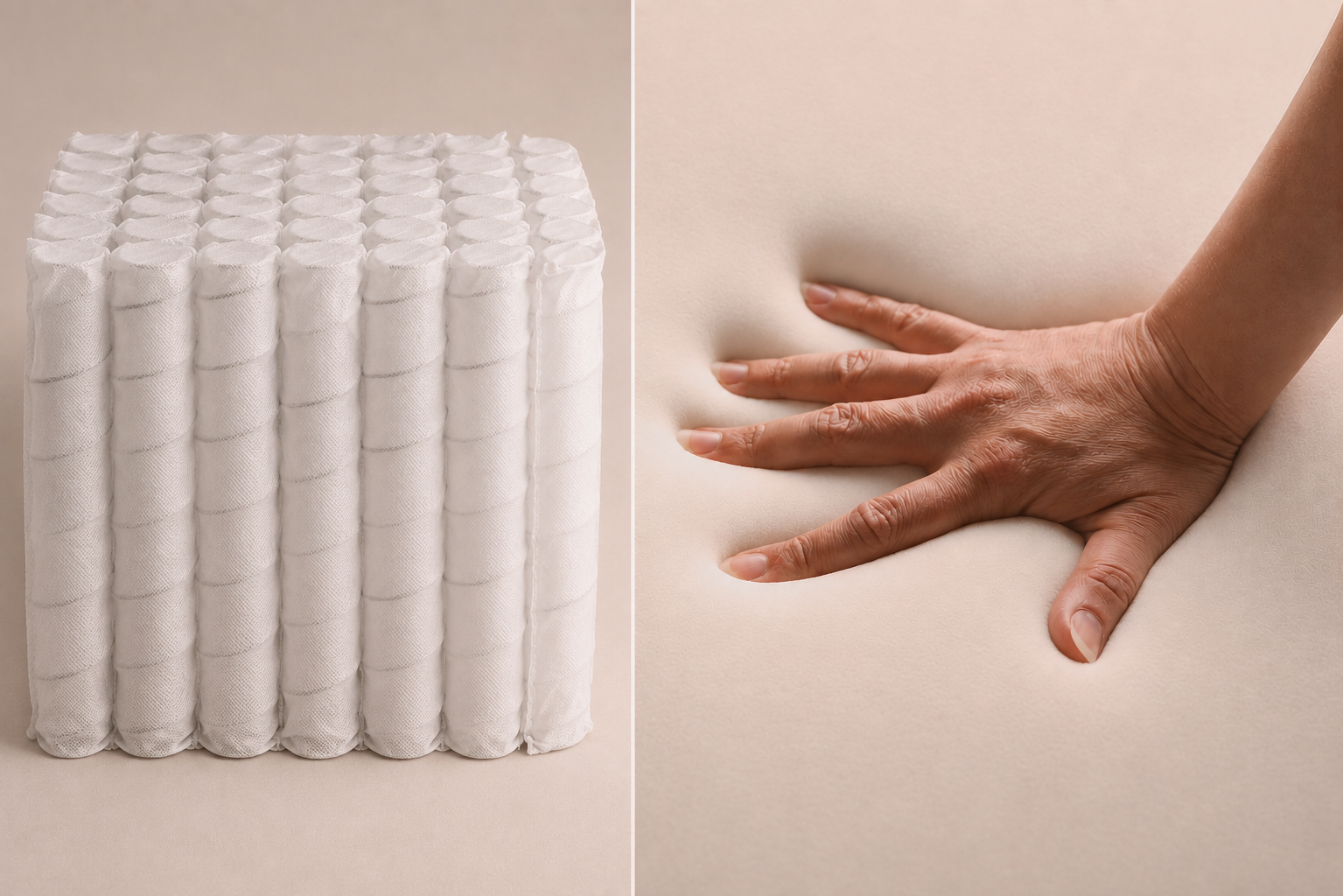
And that’s exactly where the confusion begins.
Springs sound more traditional, more reliable. Foam feels more modern, more technological. You start reading, comparing, checking reviews. Half the opinions say one thing, the other half say the exact opposite.
And at some point, you just close everything and decide to postpone the decision.
Sound familiar? That’s completely normal. The problem isn’t you. The problem is the question itself.
What do springs offer?
Springs are not an “old-school” technology. On the contrary — they are some of the most durable core systems in the mattress world.
Their biggest advantage is airflow. The space between the springs allows natural air circulation, making the mattress cooler and preventing moisture buildup.
Another advantage is that they respond to your movement. Springs react and follow you without holding you in one position. This is especially important if you move a lot during the night or share the bed with a partner.
But there is another side. Springs do not contour to the body. They lack that soft, enveloping feeling where you simply sink in and tension disappears.
What does foam offer?
Memory foam changed the way people think about comfort. Originally developed for NASA, this material adapts to the shape of your body and distributes weight evenly to relieve pressure.
For people with back or shoulder pain, this often makes a noticeable difference that can be felt as early as the first morning.
But there is also a trade-off here. Foam retains heat, especially denser memory foam layers. It can also create a sinking feeling that sometimes makes natural movement during the night harder. And for couples, motion transfer can sometimes be more noticeable than expected.
Why is the question itself flawed?
When we ask “springs or foam,” we are actually asking something else:
What compromise are you willing to make?
Comfort or coolness? Support or softness? Freedom of movement or stability?
But the truth is, this shouldn’t be a choice between two extremes.
Why CODA hybrid mattresses are exactly what you need
CODA is a brand designed to stop you from choosing between springs or foam, and instead give you both — without compromise.
CODA hybrid mattresses are not just a combination of springs and foam. They bring together the strengths of both into an engineered mattress where they work in harmony.
Pocket springs provide support, stability, and breathability. The foam layers around the core add comfort, adaptability, and pressure distribution. Instead of working against each other, they complement each other. To learn more about how pocket springs work, the different types of foam, and the other technologies used in CODA mattresses, explore our dedicated Technology page.
CODA hybrid mattresses are not a middle ground, but a solution for better sleep every night, without compromise.